

IS 2720-4 - GSA Soil Test - Grain Size Analysis | Objective, Procedure, Apparatus Used
Demystify IS 2720-4 with our casual guide to soil grain size analysis. Learn the GSA test procedure, equipment, and how to interpret results for better soil understanding.

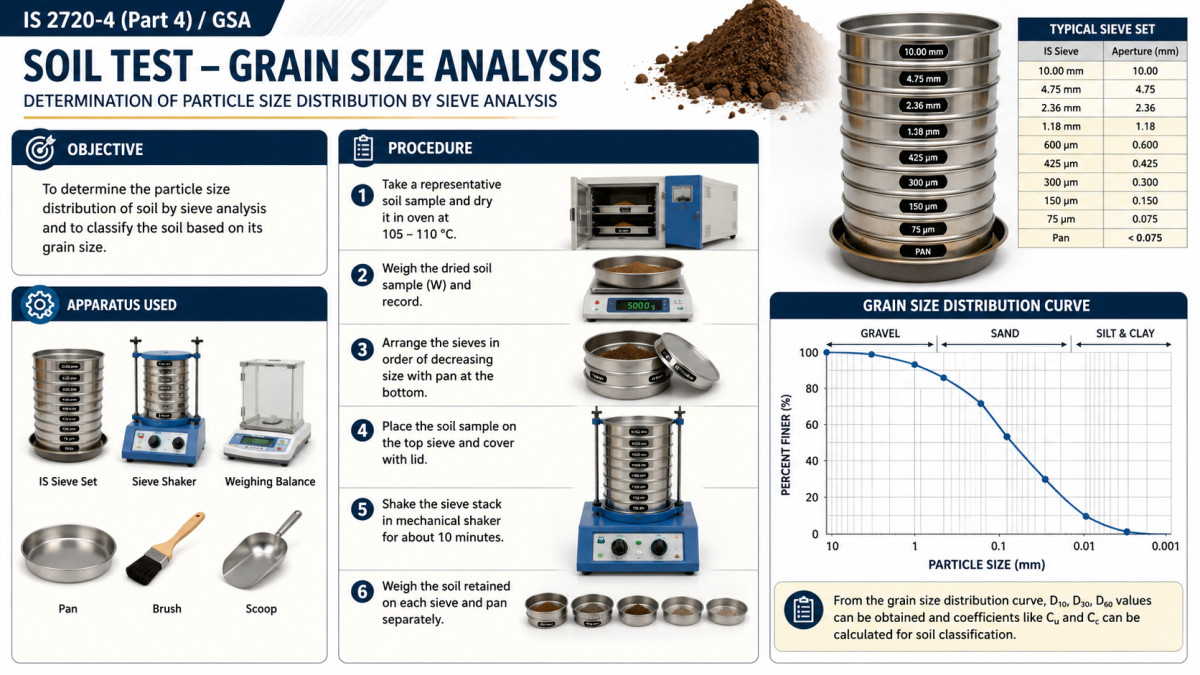
Procedure For Determination Of Grain Size Analysis
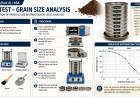
What is the GSA Test?
GSA stands for Grain Size Analysis.
It is a laboratory test aimed at determining the percentage of different particle sizes within the soil. Through this test, soil particles are classified according to their size.
The results of the GSA test provide engineers with information regarding:
- Whether the soil is well-graded or poorly-graded.
- The percentage of sand in the soil.
- The percentage of gravel in the soil.
- The content of fine particles.
- The soil’s drainage characteristics.
- Its compaction behavior.
STANDARD
- IS: 2720 (Part 4 Section 3&4) 1985.
OBJECTIVE
- To determine the Grain size analysis of soils.
APPARATUS
- Balance of capacity 15 Kg and sensitivity 1 gram.
- Sieves 75 mm, 19 mm, 4.75 mm, 2 mm, 425 micron and 75 micron conforming to IS: 460 (Part -1)1978.
- Non-corrodible trays.
- Bucket no.

GSA Test Procedure (IS 2720 Part 4)
Now, let us understand the detailed laboratory procedure for the GSA test.
Step 1: Taking the Dry Soil Sample
First, an oven-dried soil sample is taken.
The total weight of the sample is recorded.
Example:
Total Sample Weight = 1000 g
This value will be used in the calculations.
Step 2: Sieve Arrangement
The IS sieves are arranged in descending order.
The largest sieve is placed at the top, and the smallest sieve is placed at the bottom.
Arrangement:
40 mm → 20 mm → 10 mm → 4.75 mm → 2 mm → 600 micron → 425 micron → 300 micron → 150 micron → 75 micron
A pan is placed at the bottom.
Step 3: Sample Placement
The sample is carefully placed on the top sieve.
Ensure that the sample does not spill.
Step 4: Mechanical Shaking
The sieve set is shaken in a sieve shaker for approximately 10 to 15 minutes.
Shaking causes the particles to separate according to their size.
Step 5: Collection of Retained Material
The material retained on each sieve is collected and weighed.
The weight retained on each sieve is noted in the observation table.
Step 6: Recording Observations
An accurate record of the weight retained on each sieve is maintained.
GSA calculations are performed based on this data.
Observation Table for GSA Test
| Sieve Size | Weight Retained (g) |
|---|---|
| 4.75 mm | 50 |
| 2 mm | 150 |
| 600 micron | 250 |
| 425 micron | 200 |
| 300 micron | 150 |
| 150 micron | 100 |
| 75 micron | 70 |
| Pan | 30 |
Total = 1000 g
Now, let us calculate the percentage retained.
Formula:
Percentage Retained = (Weight Retained ÷ Total Sample Weight) × 100
Example:
Percentage Retained on 4.75 mm Sieve
= (50 ÷ 1000) × 100
= 5%
Detailed Calculation Table for GSA Test
| Sieve Size | Weight Retained (g) | % Retained | Cumulative % Retained | % Passing |
|---|---|---|---|---|
| 4.75 mm | 50 | 5 | 5 | 95 |
| 2 mm | 150 | 15 | 20 | 80 |
| 600 Micron | 250 | 25 | 45 | 55 |
| 425 Micron | 200 | 20 | 65 | 35 |
| 300 Micron | 150 | 15 | 80 | 20 |
| 150 Micron | 100 | 10 | 90 | 10 |
| 75 Micron | 70 | 7 | 97 | 3 |
| Pan | 30 | 3 | 100 | 0 |
Importance of the GSA Test
The GSA (Grain Size Analysis) test holds great importance in the construction industry.
When a soil sample is collected from a project site, Grain Size Analysis is the first step taken to assess its suitability.
Excessive clay content in the soil can lead to drainage issues, while an excess of gravel can make achieving proper compaction difficult.
GSA test results are utilized in the following applications:
Highway Engineering: The GSA test is crucial for the design of road embankments and subgrades.
Foundation Design: It assists in estimating the bearing capacity of the foundation.
Earth Dam Construction: It is used in the selection of filter materials and embankment materials.
Retaining Wall Design: It helps evaluate the suitability of backfill material.
Airport Pavement: The GSA test is conducted to evaluate runway subgrades.
Therefore, GSA test results are included in every geotechnical investigation report.
What's Your Reaction?
 Like
0
Like
0
 Dislike
0
Dislike
0
 Love
0
Love
0
 Funny
0
Funny
0
 Wow
0
Wow
0
 Sad
0
Sad
0
 Angry
0
Angry
0



Comments (0)