

Concrete Quantity Calculation for Construction Projects
Master essential methods for accurate concrete quantity calculation across various structural elements like slabs, beams, columns, and stairs. Optimize project budgeting and material procurement with precision.

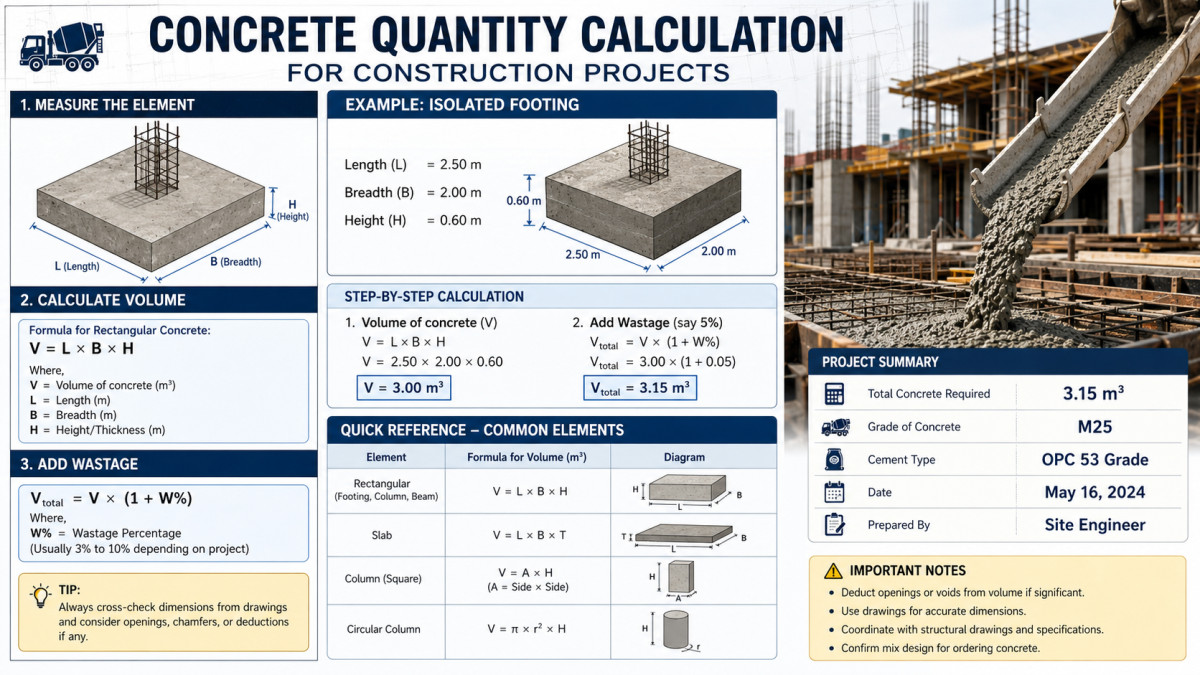
Accurate concrete quantity calculation is a cornerstone of efficient construction project management. Miscalculations can lead to significant material waste, budget overruns, or critical project delays due to shortages. This guide provides a clear, professional approach to estimating concrete volumes for various common structural elements, ensuring precision from planning to execution.
General Principles of Concrete Volume Calculation
At its core, calculating concrete quantity involves determining the volume of the space it will occupy. For most regular shapes, this is typically achieved using the fundamental formula: Volume = Length × Width × Height (or Thickness/Depth). It's crucial to always refer to detailed architectural and structural drawings for precise dimensions. Remember that these calculations yield the 'wet volume' of concrete required on-site.
Slab Concrete Calculation
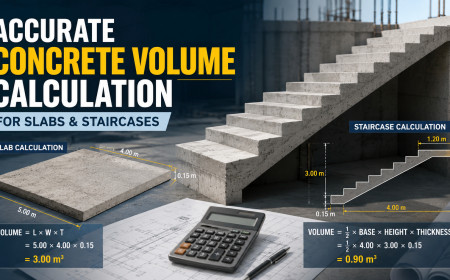
Slabs are among the most straightforward elements to quantify. Whether it's a ground slab, floor slab, or roof slab, the principle remains consistent.
- Formula: Volume = Length × Width × Thickness
- Example: For a slab measuring 10 meters long, 5 meters wide, and 0.15 meters thick:
- Volume = 10 m × 5 m × 0.15 m = 7.5 cubic meters (m³)
Beam Concrete Calculation
Beams provide structural support and are typically rectangular or square in cross-section. Their volume calculation is similar to that of a slab but with different dimensions.
- Formula: Volume = Length × Width (or Breadth) × Depth (or Height)
- Example: For a beam 6 meters long, 0.3 meters wide, and 0.45 meters deep:
- Volume = 6 m × 0.3 m × 0.45 m = 0.81 m³
Column Concrete Calculation
Columns are vertical structural elements designed to transfer loads. Their volume depends on their cross-sectional shape and height.
- For Rectangular/Square Columns:
- Formula: Volume = Length × Width × Height
- Example: A square column 0.4 m × 0.4 m with a height of 3 meters:
- Volume = 0.4 m × 0.4 m × 3 m = 0.48 m³
Circular Concrete Calculation (e.g., Circular Columns, Piles)
When dealing with circular elements such as columns or concrete piles, the cross-sectional area is determined by the circle's dimensions.
- Formula: Volume = π × (Radius)² × Height (where π ≈ 3.14159)
- Example: A circular column with a 0.3-meter radius and 4 meters height:
- Volume = 3.14159 × (0.3 m)² × 4 m = 3.14159 × 0.09 m² × 4 m ≈ 1.13 m³
Stair Concrete Calculation
Stairs present a slightly more complex calculation due to their varying geometry. They typically consist of a waist slab and a series of steps (treads and risers). A common method is to calculate the volume of the inclined waist slab separately from the volume of the steps.
- 1. Calculate Waist Slab Volume:
- Determine the horizontal run (R) and vertical rise (H) of the flight.
- Calculate the inclined length (L_inclined) using Pythagoras theorem: L_inclined = √(R² + H²)
- Waist Slab Volume = L_inclined × Width of Stair × Thickness of Waist Slab
- 2. Calculate Step Volume:
- Volume of one step triangle = (1/2 × Tread Length × Riser Height)
- Total Step Volume = Volume of one step triangle × Number of Steps × Width of Stair
- Total Stair Concrete Volume = Waist Slab Volume + Total Step Volume
- Example: A stair with 10 steps, each with a 0.3 m tread and 0.15 m riser, a 1.2 m width, and a 0.1 m waist slab thickness. Total horizontal run = 10 * 0.3 = 3m. Total vertical rise = 10 * 0.15 = 1.5m.
- L_inclined = √((3m)² + (1.5m)²) = √(9 + 2.25) = √11.25 ≈ 3.354 m
- Waist Slab Volume = 3.354 m × 1.2 m × 0.1 m ≈ 0.402 m³
- Volume of one step triangle = (1/2 × 0.3 m × 0.15 m) = 0.0225 m²
- Total Step Volume = 0.0225 m² × 10 steps × 1.2 m = 0.27 m³
- Total Stair Volume ≈ 0.402 m³ + 0.27 m³ = 0.672 m³
Wall Concrete Calculation
Concrete walls, often used as retaining walls, shear walls, or basement walls, are straightforward to estimate.
- Formula: Volume = Length × Height × Thickness
- Example: A concrete wall 8 meters long, 2.5 meters high, and 0.2 meters thick:
- Volume = 8 m × 2.5 m × 0.2 m = 4 m³
Mastering these calculations is fundamental for any construction professional. Always double-check your measurements against drawings and consider a small contingency factor for waste and unforeseen circumstances. Accurate estimation not only saves costs but also streamlines the entire construction process, leading to more successful project outcomes.
What's Your Reaction?
 Like
0
Like
0
 Dislike
0
Dislike
0
 Love
0
Love
0
 Funny
0
Funny
0
 Wow
0
Wow
0
 Sad
0
Sad
0
 Angry
0
Angry
0



Comments (0)