

GSB Sieve Analysis: MoRTH 400-1 Grade-I Excel & PDF Templates
GSB Sieve Analysis for road construction with MoRTH Table 400-1, Grade-I. Explore essential Excel & PDF templates for accurate, compliant material testing and reporting.

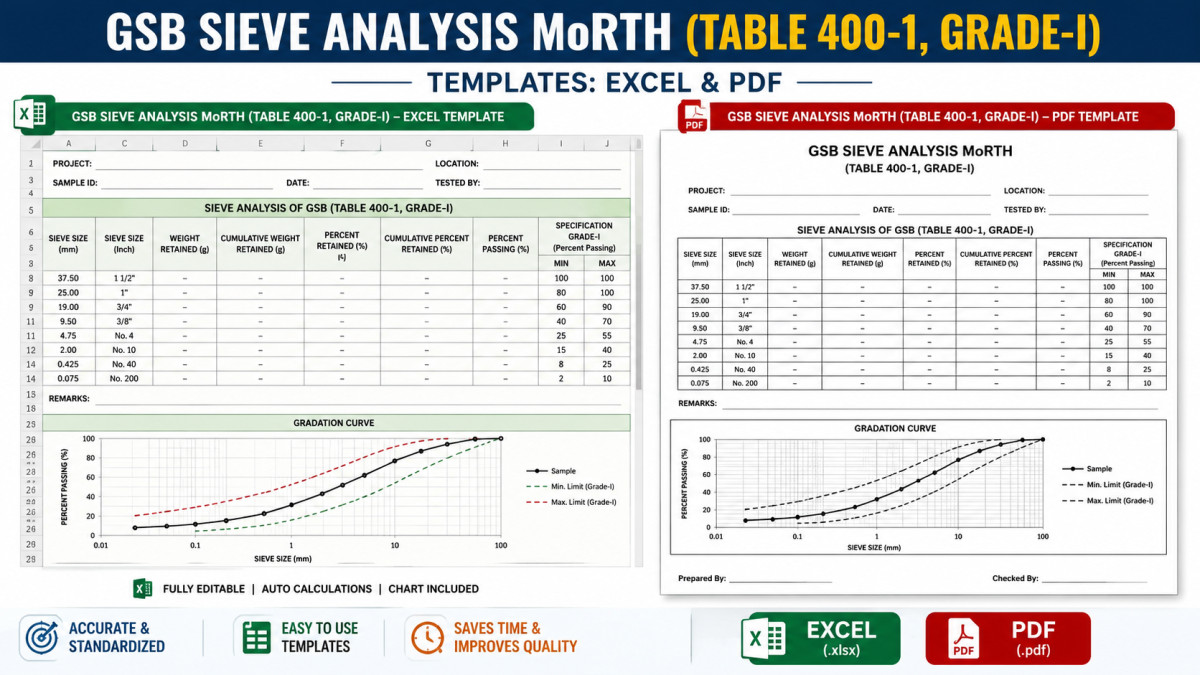
The foundation of any robust road infrastructure lies in the quality of its sub-base layers. Among these, the Granular Sub-base (GSB) plays a pivotal role, providing structural support, drainage, and a stable platform for subsequent layers. Ensuring the quality of GSB material is paramount, and this is where rigorous testing, particularly sieve analysis, becomes indispensable. Adherence to specifications laid out by authorities like the Ministry of Road Transport and Highways (MoRTH) in India is not just a regulatory requirement but a cornerstone of durable construction.

MoRTH Table 400-1, Grade-I, specifically outlines the grading requirements for Granular Sub-base material. This specification dictates the permissible percentages of material passing through various sieve sizes, ensuring the aggregate possesses the necessary particle size distribution for optimal performance. Deviations from these precise gradations can lead to issues such as poor compaction, inadequate drainage, and ultimately, premature pavement failure. Therefore, accurate and consistent sieve analysis is critical for quality assurance and the longevity of road projects.

Understanding the GSB Sieve Analysis Process
The GSB sieve analysis process involves drying, weighing, and passing a material sample through a series of sieves. The retained weights are then used to calculate cumulative percentages and percentages passing, which are critically compared against MoRTH Table 400-1, Grade-I limits. Manually performing these calculations and recording data is time-consuming and highly susceptible to human error, potentially leading to non-compliant material usage and inconsistent quality control.
Streamlining with GSB Sieve Analysis Templates
To mitigate these challenges and enhance efficiency, professional templates for GSB sieve analysis have become invaluable tools. Specifically designed Excel and PDF templates offer structured frameworks for data entry, automated calculations, and standardized reporting, ensuring accuracy and compliance with MoRTH specifications.
Excel Templates: Precision and Automation
- Automated Calculations: Automated formulas for cumulative percentages and passing rates eliminate manual errors, speeding up analysis.
- Instant Grading Curves: Instantly generate visual grading curves for quick assessment against MoRTH limits.
- Error Reduction: Automation minimizes human error in calculations, ensuring reliable test results.
- Efficient Data Management: Robust capabilities for storing, organizing, and analyzing multiple test results, aiding trend analysis.
- Customization & Flexibility: Adaptable for project-specific details while maintaining MoRTH compliance.
PDF Templates: Standardization and Field Utility
- Standardized Reporting: Ensures consistent, professional report formats, crucial for compliance and auditing.
- Field Data Collection: Printable templates facilitate easy on-site data recording, ensuring uniform information capture.
- Secure Records: Completed PDF reports offer non-editable, tamper-proof records, vital for compliance and archiving.
- Universal Accessibility: Viewable across most devices without specialized software, enhancing team shareability.
- Efficient Archiving: Simplifies organized digital archiving, allowing easy retrieval for future audits.
Integrating these specialized templates into a construction project's quality assurance workflow transforms GSB sieve analysis. It shifts from an error-prone, time-consuming task to an efficient, accurate, and compliant operation. Leveraging Excel's analytical power and PDF's standardized reporting, project managers ensure granular sub-base material consistently meets MoRTH Table 400-1, Grade-I requirements. This proactive approach safeguards pavement integrity and contributes to cost savings by preventing reworks and delays.
In conclusion, for road construction projects prioritizing excellence and MoRTH compliance for GSB (Table 400-1, Grade-I), professional Excel and PDF sieve analysis templates are essential best practices. These tools empower teams with precise material testing, streamlined data management, and impeccable reports, laying the groundwork for durable, high-performing infrastructure.
What's Your Reaction?
 Like
0
Like
0
 Dislike
0
Dislike
0
 Love
0
Love
0
 Funny
0
Funny
0
 Wow
0
Wow
0
 Sad
0
Sad
0
 Angry
0
Angry
0



Comments (0)