

Concrete Cube Compressive Strength Test (IS 516) – Excel & PDF Templates
Master concrete quality control with our IS 516 compliant compressive strength test templates. Download ready-to-use Excel & PDF forms for accurate data recording and analysis.

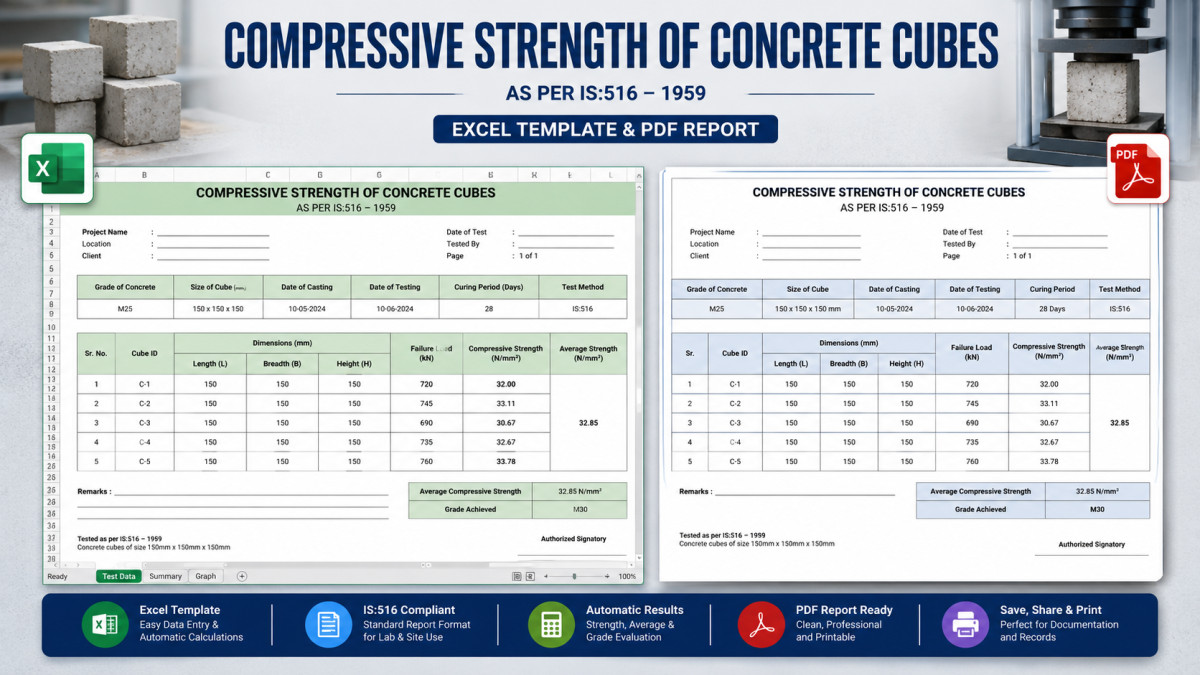
The compressive strength of concrete is a fundamental property that dictates its performance and durability in any construction project. It is the primary indicator of concrete quality, directly influencing structural integrity and safety. Ensuring that concrete meets specified strength requirements is paramount, and this is achieved through rigorous testing, most commonly on concrete cubes.
In India, the standard procedure for determining the compressive strength of concrete is outlined in IS:516 – "Methods of Tests for Strength of Concrete". This standard provides a comprehensive guide for preparing, curing, and testing concrete specimens, ensuring uniformity and reliability in results across the industry. Adherence to IS:516 is critical for long-term performance and safety, specifying cube dimensions (e.g., 150mm), curing, and loading rates during the test, among other parameters.
The testing process involves casting concrete into standard molds, curing them under controlled conditions for specified periods (e.g., 7, 14, 28 days), and then subjecting them to a compressive load in a Universal Testing Machine (UTM) until failure. Recording accurate data during this process is crucial for proper analysis and decision-making. Manual recording can be prone to errors and inefficiencies, which is where standardized templates become invaluable tools.

Streamlining Data Management with Templates
To effectively manage the data generated from compressive strength tests, standardized templates in both Excel and PDF formats offer significant advantages. These templates are designed to capture all necessary information systematically, from project details and mix design to individual cube test results, ensuring consistency and ease of review.
Excel Templates for Dynamic Analysis
- Automated Calculations: Pre-programmed for strength and average calculations, reducing manual errors.
- Data Trending and Analysis: Tracks strength development, identifies trends, and compares to limits for effective quality control.
- Customizable Reports: Easily generates charts, graphs, and summary reports for clear presentation to stakeholders.
- Error Reduction: Standardized input fields and validation rules minimize data entry mistakes, enhancing record accuracy.
PDF Templates for Standardized Documentation
- Print-Ready Format: Ideal for professional, shareable, and archived official documentation.
- Field Use: Printable for on-site data recording by technicians, ensuring consistent information capture.
- Official Records: Maintains formatting integrity for formal submissions to clients, consultants, or regulatory bodies.
- Consistency: Ensures all necessary fields are present, maintaining uniform reporting standards across projects.
Key Information Captured by Templates
Both Excel and PDF templates for concrete compressive strength testing typically include sections for:
- Project Name and Location
- Client/Consultant Details
- Mix Design Reference
- Date of Casting and Testing
- Cube Identification Number
- Age of Cube at Testing (e.g., 7-day, 28-day)
- Dimensions of Cube
- Weight of Cube (optional, for density checks)
- Failure Load (kN)
- Calculated Compressive Strength (N/mm²)
- Average Strength of a Set of Cubes
- Remarks/Observations (e.g., type of failure)
- Signature of Testing Engineer/Supervisor
Utilizing these meticulously designed templates significantly enhances the efficiency, accuracy, and reliability of concrete quality control. They simplify data recording and analysis, ensure strict adherence to standards like IS:516, and provide a robust framework for documenting structural integrity. Investing in such tools is an investment in quality, compliance, and the safety and longevity of infrastructure.
What's Your Reaction?
 Like
0
Like
0
 Dislike
0
Dislike
0
 Love
0
Love
0
 Funny
0
Funny
0
 Wow
0
Wow
0
 Sad
0
Sad
0
 Angry
0
Angry
0

Comments (0)