

Concrete Pour Card Templates: Excel & PDF for Quality Control
Streamline your concrete quality control with our free, professional concrete pour card templates in Excel and PDF formats. Essential for accurate record-keeping and project success.

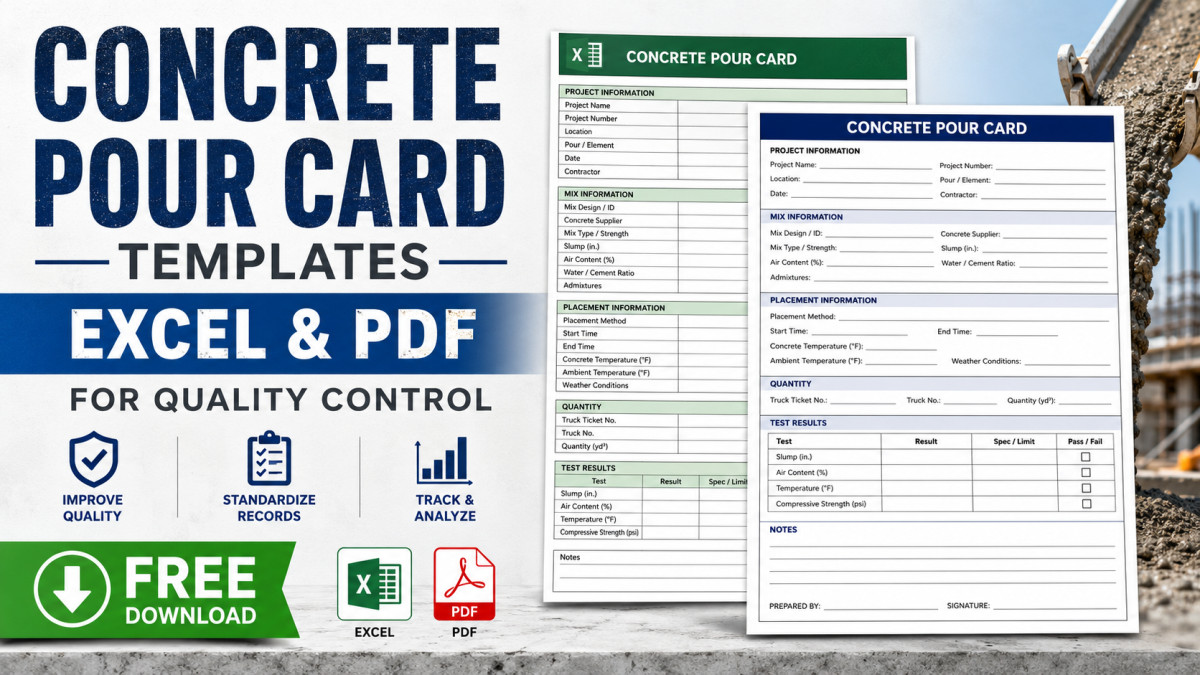
In the demanding world of construction, precision and documentation are paramount, especially when it comes to concrete pours. A concrete pour card, also known as a pour log or concrete inspection checklist, is an indispensable tool for ensuring the quality, integrity, and compliance of concrete elements on any project. It serves as a vital record of critical information captured during the concrete placement process, from initial delivery to final finishing.
In the demanding world of construction, precision and documentation are paramount, especially when it comes to concrete pours. A concrete pour card, also known as a pour log or concrete inspection checklist, is an indispensable tool for ensuring the quality, integrity, and compliance of concrete elements on any project. It serves as a vital record of critical information captured during the concrete placement process, from initial delivery to final finishing.

The Indispensable Role of Concrete Pour Cards
The primary function of a concrete pour card is to provide a detailed, real-time snapshot of conditions and properties at the moment of a pour. This meticulous record-keeping is not merely good practice; it is fundamental for several reasons:
- Quality Assurance: By documenting mix design, slump, air content, temperature, and other vital parameters, pour cards help verify that the concrete meets specified requirements and standards.
- Problem Identification: Should issues arise later, such as cracks or strength deficiencies, a comprehensive pour card can be instrumental in tracing the root cause, identifying specific batches or conditions that may have contributed to the problem.
- Compliance and Auditing: Regulatory bodies and project owners often require detailed records of concrete pours. Pour cards provide the necessary documentation for audits, inspections, and legal compliance.
- Dispute Resolution: In cases of disputes related to concrete quality, an accurate and complete pour card offers objective evidence of the conditions at the time of placement.
- Historical Data: Over time, accumulated pour card data can offer valuable insights for future projects, helping to refine processes and improve material specifications.
Key Information Captured on a Concrete Pour Card
A robust concrete pour card typically includes the following essential information:
- Project Details: Project name, location, pour date, and specific structural element.
- Concrete Supplier Info: Supplier name, batch plant, truck number, and delivery ticket.
- Mix Design: Specified strength, mix ID, cement type, aggregate sizes, and admixtures.
- Environmental Conditions: Ambient temperature, ground temperature, and weather.
- Concrete Properties:
- Slump Test: Measured slump.
- Air Content: Percentage of entrained air.
- Concrete Temperature: Temperature of fresh concrete.
- Placement Information: Start/end times, method of placement, and any delays.
- Curing Method: Details of the curing process initiated.
- Sample Information: Number and type of test cylinders/beams, and their IDs.
- Inspecting Personnel: Names and signatures of inspectors and representatives.
- Remarks: Any observations or unusual occurrences during the pour.
Leveraging Free Excel and PDF Formats
The availability of free concrete pour card templates in both Excel and PDF formats offers significant advantages for construction professionals. A PDF format provides a standardized, print-ready document that ensures consistency across all records. It’s ideal for manual data entry on-site and archiving. Its fixed layout prevents accidental modifications, making it a reliable format for official documentation.
On the other hand, an Excel format offers unparalleled flexibility and functionality. Users can easily customize fields to fit specific project needs, add formulas for automated calculations (e.g., volume calculations), and integrate data with other project management tools. The digital nature of Excel also facilitates data analysis, allowing for quick sorting, filtering, and reporting, which can be invaluable for identifying trends or potential issues across multiple pours. Both formats support efficient record-keeping, reducing errors and saving valuable time.
By utilizing these readily available, free templates, construction teams can significantly enhance their quality control processes, ensure compliance, and build a robust foundation of documentation for every concrete pour. Download your preferred format today to streamline your project's concrete management.
The Indispensable Role of Concrete Pour Cards
The primary function of a concrete pour card is to provide a detailed, real-time snapshot of conditions and properties at the moment of a pour. This meticulous record-keeping is not merely good practice; it is fundamental for several reasons:
- Quality Assurance: By documenting mix design, slump, air content, temperature, and other vital parameters, pour cards help verify that the concrete meets specified requirements and standards.
- Problem Identification: Should issues arise later, such as cracks or strength deficiencies, a comprehensive pour card can be instrumental in tracing the root cause, identifying specific batches or conditions that may have contributed to the problem.
- Compliance and Auditing: Regulatory bodies and project owners often require detailed records of concrete pours. Pour cards provide the necessary documentation for audits, inspections, and legal compliance.
- Dispute Resolution: In cases of disputes related to concrete quality, an accurate and complete pour card offers objective evidence of the conditions at the time of placement.
- Historical Data: Over time, accumulated pour card data can offer valuable insights for future projects, helping to refine processes and improve material specifications.
Key Information Captured on a Concrete Pour Card
A robust concrete pour card typically includes the following essential information:
- Project Details: Project name, location, pour date, and specific structural element.
- Concrete Supplier Info: Supplier name, batch plant, truck number, and delivery ticket.
- Mix Design: Specified strength, mix ID, cement type, aggregate sizes, and admixtures.
- Environmental Conditions: Ambient temperature, ground temperature, and weather.
- Concrete Properties:
- Slump Test: Measured slump.
- Air Content: Percentage of entrained air.
- Concrete Temperature: Temperature of fresh concrete.
- Placement Information: Start/end times, method of placement, and any delays.
- Curing Method: Details of the curing process initiated.
- Sample Information: Number and type of test cylinders/beams, and their IDs.
- Inspecting Personnel: Names and signatures of inspectors and representatives.
- Remarks: Any observations or unusual occurrences during the pour.
Leveraging Free Excel and PDF Formats
The availability of free concrete pour card templates in both Excel and PDF formats offers significant advantages for construction professionals. A PDF format provides a standardized, print-ready document that ensures consistency across all records. It’s ideal for manual data entry on-site and archiving. Its fixed layout prevents accidental modifications, making it a reliable format for official documentation.
On the other hand, an Excel format offers unparalleled flexibility and functionality. Users can easily customize fields to fit specific project needs, add formulas for automated calculations (e.g., volume calculations), and integrate data with other project management tools. The digital nature of Excel also facilitates data analysis, allowing for quick sorting, filtering, and reporting, which can be invaluable for identifying trends or potential issues across multiple pours. Both formats support efficient record-keeping, reducing errors and saving valuable time.
By utilizing these readily available, free templates, construction teams can significantly enhance their quality control processes, ensure compliance, and build a robust foundation of documentation for every concrete pour. Download your preferred format today to streamline your project's concrete management.
What's Your Reaction?
 Like
0
Like
0
 Dislike
0
Dislike
0
 Love
0
Love
0
 Funny
0
Funny
0
 Wow
0
Wow
0
 Sad
0
Sad
0
 Angry
0
Angry
0




Comments (0)